TOTEM BODY

Exploring A New Earth Consciousness

Aberystwyth University School of Art PhD

Barry Cottrell 2011/12

aviatorsmallerweb

Please note

The research has shifted to a new focus and its title is The Driven Line – 100,000 Years of Engraving. A revised webpage for this research is currently under construction.

Introduction

This research will investigate a specific new ‘myth’ of the human body. The physical body is widely understood today in terms of the reductionist, molecular model of medical bioscience. This thesis will explore an alternative, radically holistic model of the human body, fusing rational with non-rational participatory forms of knowing. The primary narrative expressions of the research will be pictorial/sculptural and written.


In the context of this thesis, myths are understood psychologically as “constellations of thoughts, feelings, images, motives, values and priorities.”1 They take the form of “explanatory narratives...both within and outside of awareness…that address existential human issues.”2 ‘Myth-making’ is seen as “the primary… psychological mechanism by which human beings order reality and navigate their way through life.”3 While myths are commonly misunderstood as ‘superstitious falsehoods,’ this is “a formulation which belies the reductionism of modern technological, industrial societies.”4


Burin Engraving on Copper

The pictorial/sculptural expression of this thesis will be through the medium of burin engraving on copper. Engraving has been the main focus of my work as an artist for twenty-five years. Occupying the region between sculpture and graphic art, engraving was described by William Blake as 'drawing in copper,' while the 20th century French engraver Roger Vieillard argued that to engrave is “to draw in three-dimensional space.”5 As an engraving is specifically linear, Vieillard felt that the technique was not suited to representation of the natural, visible world. Rather, the artist is “compelled to express a personal interpretation and a personal vision.” The engraver is like a poet or a writer, “describing his dreams rather than what he sees.”6


I experience the act of engraving as 'the driven line,' born of a 'secret geometry' - forward action of the steel burin and circular counteraction of the resistant copper plate. Sustaining and mobilising the opposition between these forces gives rise to the elastic tension and distinctive character of the engraved line. I see my engravings as 'poetry of the driven line,' lyrical images which are sculptural in origin, graphic in destination, and informed by imagination.


My work as an engraver is influenced technically by the engraving of late 15th century masters like Martin Schongauer and Andrea Mantegna, and also by the 20th century renaissance of gravure initiated by S.W. Hayter and Joseph Hecht in Paris. Hayter wrote of Hecht that he “saw the character of life in the line itself, not the description of life by means of the line.”7 For me this is the essence of engraving. In the act of engraving, marks and lines come alive, communicating an energetic, joyful, elastic tension arising from contact between the cold steel of the burin and the luminous warmth of the copper plate.


Research Questions & Objectives

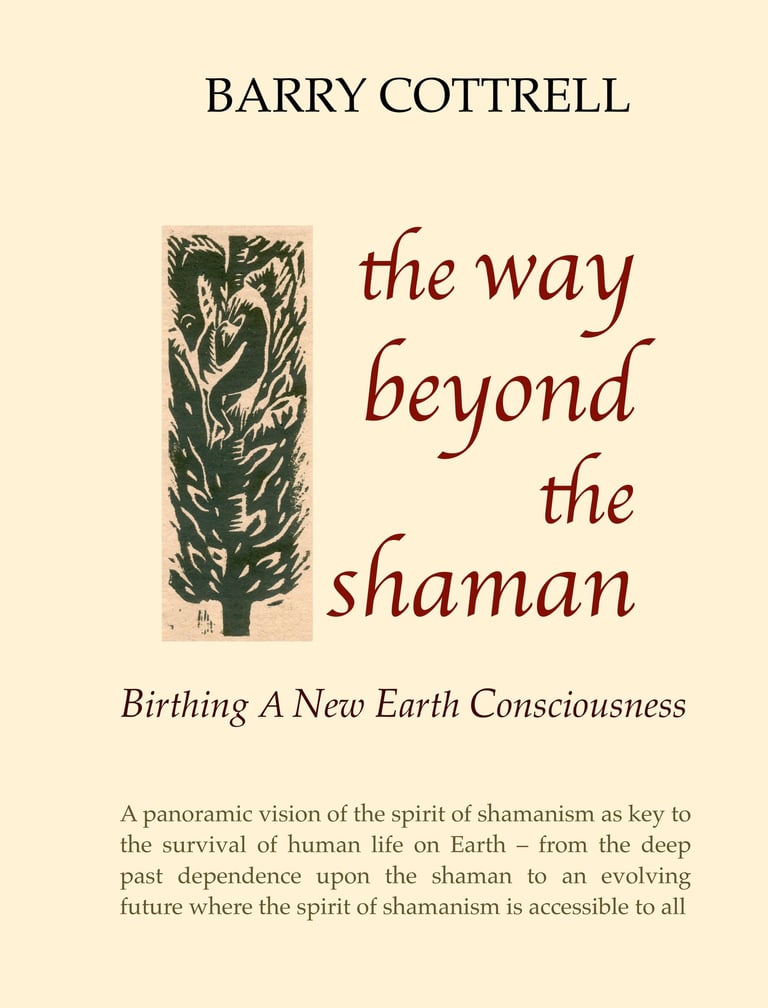
The idea behind this research originates from my book, The Way Beyond The Shaman - Birthing A New Earth Consciousness (O Books, 2008) which presents a new vision and understanding of our relationship with the Earth, based on the recognition of the ‘spirit of shamanism.’ Central to this vision is an awareness of the human body as being part of the Earth.


In Western civilization the human body has long been seen as a symbol of the isolated, Cartesian self, separate from and superior to all other forms of life in the natural world. Against this dominant construct, the research in Totem Body will explore and present both visual and textual elaborations of a more indigenous, shamanic and totemic understanding of the human body. The body will be presented as emblematic of a more expanded, social and inclusive self, expressing our universal, shared species-specific humanity and the mutuality of our inter-species relationships. It will be seen less as a symbol of our separation from each other and the planet, and more as “an experience of utter participation with the life of planet Earth” and with each other.8 Totemism, in particular, affirms the relationship between humans and animals as participating in a shared existence.


Totems have been described by writer, Vanessa Carlisle, as “symbols of unity and tools for transcending oppressive systems of thought and being.”9 In Totem Body the concept is developed further so that the human body itself is understood and portrayed as being a totem object in its own right, a ‘symbol of unity’ with other human beings, and also as an animal body with its own intrinsic ‘power’ — a shamanic ‘power animal.’ The main aim of this research could therefore be articulated as a contribution towards the “recovery of indigenous mind.”10


Research Context

French sociologist and anthropologist, Bruno Latour, recently commented: “the planet will no longer be modernized. Something radically different is going on.”11 This research project is generally aligned to the position that we are living in a transitional period, in “a borderline region between modernity and a new as yet inadequately theorized, social situation.”12 The challenge of postmodernism has already thrown into doubt the Grand Narrative of Progress and reliance on reason, which characterized Western modernity, while process philosophy views pre-rational experience, or feelings, as our primary means of knowing the world. The non-rational participatory epistemologies of indigenous and other non-Western traditions point to alternate realities; together, these avenues might fuse leading to “something radically different,” to new transmodern myths, and a refreshment of both personal and collective narratives beyond the “morass of deferred solutions on every level” - along with the cynicism and erosion of meaning - which many find in contemporary postmodernism.13 American writer and anthropologist, Richard Grossinger, is one of the harbingers of the radically new: “As long as we profess and practice ignorance about our own creature manifestation and do not develop our energetic potentialities, we forget the crux of our astonishing existence.”14


Practical Considerations

The text of this thesis will elaborate the concepts of totemism, neototemism, shamanism and neoshamanism, and present the rationale for how the human body – which is also an animal body – may be conceived of as a totem object and power animal in its own right.


The pictorial/sculptural expression of this thesis will be through the medium of burin engraving on copper. More specifically I propose to engrave a series of copper plates which will be cut into shapes describing figures in certain ‘sacred postures.’ The work of anthropologist Felicitas Goodman has drawn attention to a number of bodily postures which have been associated with visionary experiences in altered states of consciousness.15 The engravings executed during this research project would illustrate and highlight the totemic and shamanic themes elaborated in the written thesis.


The engraved copper plates will be works of considerable labour and very heavily detailed. Please see, for example, as a prototype, my Chinese Dragon engraving (Le Dragon de Chine) from 1987 in the supporting visual material. The purpose of this method of working will be to link the present to the past, honouring the ancient tradition of goldsmiths and silversmiths who engraved precious metals throughout the millennia, and from whose skills the more recent 15th century technique of engraving as a graphic art evolved.


Notes

1. Krippner, Stanley & Feinstein, David. “A Mythological Approach to Transpersonal Psychotherapy.”

ReVision 30 (1 & 2), 2009, p. 21.

2. Ibid.

3. Ibid.

4. Ibid.

5. Hacker, P.M.S. (ed.). “The engravings of Roger Vieillard” in Gravure and Grace, exhibition

catalogue of Vieillard’s engravings, Ashmolean Museum, 26 October 1993 – 16 January 1994, p. 8.

6. Vieillard, Roger. ‘De la gravure originale”, Nouvelles de l’estampes, no.100, October 1998,

p.20. In Hacker, P.M.S. (ed.). Gravure and Grace, (above), p. 92.

7. Hayter, Stanley William. New Ways of Gravure. New York: Watson-Guptill Publications, 1981,

p. 200.

8. Cottrell, Barry. The Way beyond the Shaman - Birthing a New Earth Consciousness.

Winchester, UK & Washington, USA, 2008, p. 114.

9. Carlisle, Vanessa. “Totem and Fetish.” Georgeous Curiosity – Gems for Threadbare Pockets.

Thursday, February 5th, 2009. http://gorgeouscuriosity.blogspot.com/search?q=totem.

10. Kremer, Jürgen W. “Shamanic Inquiry As Recovery of Indigenous Mind. Toward an egalitarian

exchange of knowledge.” Published in Schenk & Ch. Rätsch (Eds.) 1999, What is a shaman?

Journal for Ethnomedicine, special volume 13, 125 -140. Berlin: VWB – Verlag für Wissenschaft und Bildung.

11. Latour, Bruno. “Will Non-humans be Saved? An Argument in Ecotheology.” The Henry Myers

Lecture – Royal Institute of Anthropology. 13th April 2009. P. 3

12. Gabardi, Wayne. Negotiating Postmodernism. University of Minnesota Press, 2000, p. 15.

13. Zerzan, John. “ The Catastrophe of Postmodernism.”

http://www.primitivism.com/postmodernism.htm

14. Grossinger, Richard. The Bardo of Waking Life. Berkeley, California: North Atlantic Books,

2008, p. 186.

15. Goodman, Felicitas D. Where Spirits Ride The Wind – Trance Journeys And Other Ecstatic

Experiences. Indiana University Press, 1990.